The Changing Landscape of Business Education
Business education has undergone a significant transformation, especially when there is a growing demand from businesses to develop leaders who are not only knowledgeable in theory but also possess practical decision-making skills. While lectures and case studies remain valuable in business education, management programs are increasingly emphasizing interactive learning methods that prepare students for real-world business situations.
Many of the top business schools and the best management colleges are changing their MBA programs to incorporate learning methods that are practical and can help in business learning.
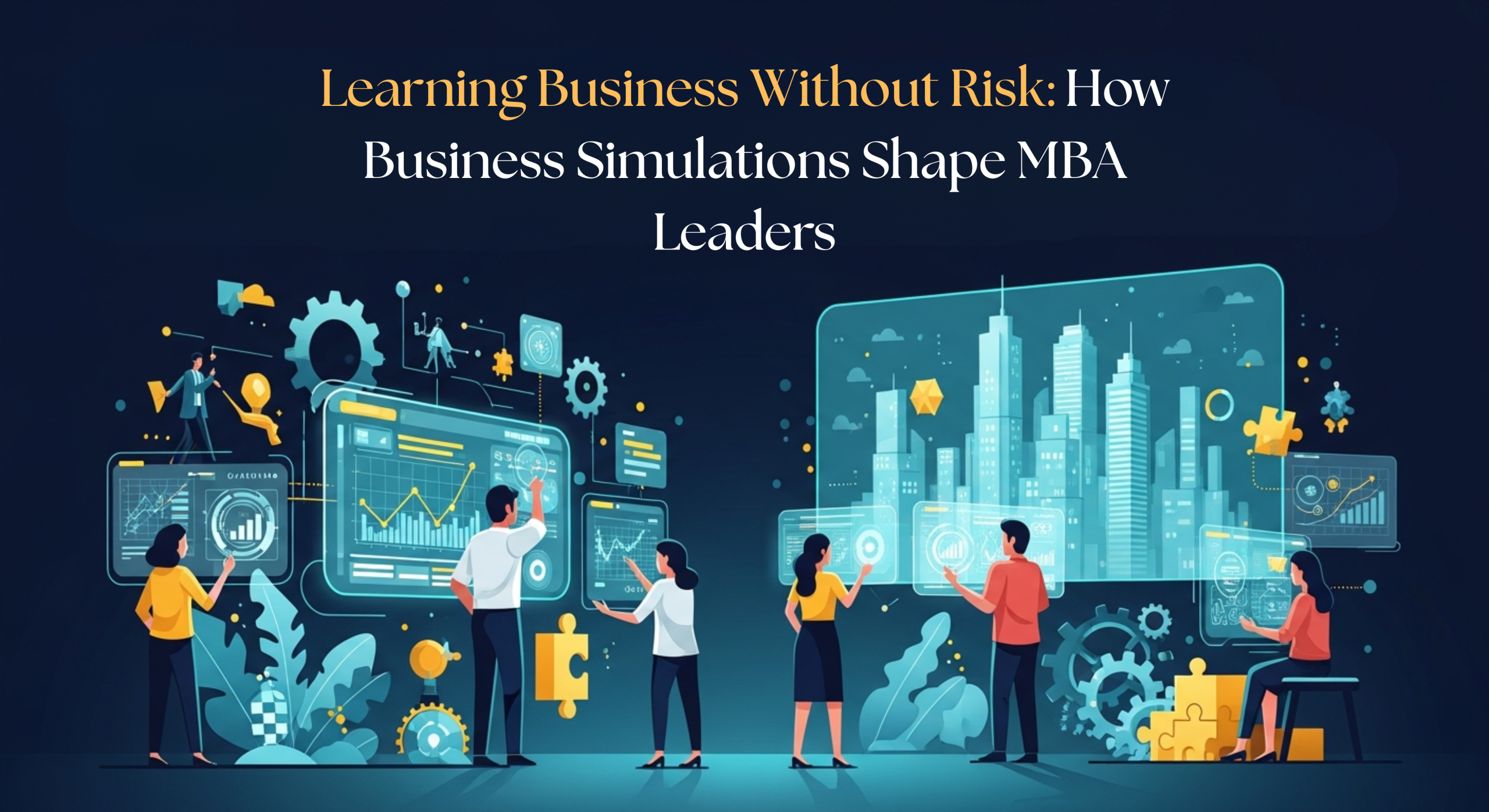
One of the most influential innovations in facilitating this transition is business simulations. Simulations are computer-based programs that immerse students in a virtual business environment, requiring them to manage operations and adapt to changing conditions.
Simulation-based learning can also help students develop skills in analyzing data, assessing competition, and adapting strategies according to market trends. By this approach, students of MBA realize how business decisions can impact profitability and brand building. By using advanced technology in management education, it is possible to provide students with an actual business environment.
Business Simulations and Experiential Learning
The emphasis on experiential learning has made simulations an integral part of MBA courses. Instead of studying management theories in the traditional way, students gain practical experience by making decisions in scenarios that replicate real business challenges.
This helps them get more involved in learning and relate theories to practice.
In simulation platforms, participants may be required to manage various aspects of a virtual organization such as marketing, finance, operations, and product development. Students get to analyze data related to the market and compete with other organizations through proper decision-making. Such a process of decision-making is very effective in improving analytical skills.
Another area improved by the use of simulation learning is the enhancement of strategic thinking. The market environment changes depending on the actions of the participants, and the students are forced to think and change their strategy. This process mirrors the real environment, which changes depending on the strategies put in place.
Simulations also foster collaborative learning. Most simulations require students to work in groups, thus encouraging cooperation and teamwork. From this, students are able to develop professional skills such as negotiation and coordination of tasks, as well as team work.
The key advantages of the simulation-driven learning process for the MBA program include:
- Strengthening the leadership development aspect of the MBA program
- Enhancing the strategic thinking and long-term business strategy planning
- Providing the practice of decision-making in competitive scenarios
- Encouraging team collaboration and problem-solving skills
- Developing the understanding of the importance of risk management in the operations of the business
- Building the confidence of the students with the experience of the real-world business environment
The advantages of the simulation process explain its popularity among the top B schools and innovative management institutions worldwide.
Building Leadership Skills Through Risk-Free Education
One of the major strengths of simulation-based learning is the ability to learn through trial and error without suffering actual consequences. In a real business scenario, incorrect business decisions can cause financial losses and harm to business reputation. In simulation-based business scenarios, incorrect business decisions can prove to be beneficial.
Through repeated simulation exercises, MBA students are able to understand how to analyze uncertainty, manage limited resources, and adapt to changing markets. These exercises help in better risk management and evaluation of various business alternatives before making decisions.
Simulations help in MBA leadership development since students are exposed to roles that resemble business leaders. They have to manage teams, understand financial reports, and implement business strategies that impact business performance. This helps in better management skills and how leadership impacts business outcomes.
Simulation-based learning can also enhance adaptability. This is due to the fact that, considering the rapid technological changes, global competitiveness, and dynamic consumer behavior, students must learn to adapt strategies and find innovative solutions to situations. This helps students to be able to manage uncertainties confidently.
Simulation-Based Learning at FBS Business School
Institutions that strive to offer industry-oriented learning have come to incorporate simulation learning methodologies. FBS Business School incorporates business simulation and modern technology in its management courses. This approach focuses on experiential learning, collaborative work, and strategic problem-solving exercises that mimic reality in business environments.
This approach enables FBS students to acquire knowledge in academic fields and apply it in practical experiences. It helps in the development of strategic thinking and collaboration skills while offering exposure to decision-making in a business simulation environment.
Conclusion
The rising popularity of business simulation in MBA education is a reflection of the changing approach to learning, which is more “practical” and “technology-driven.” Business simulation offers “risk-free” education where students can “test” and “improve” decision-making and business management skills. Strategic thinking and teamwork are also promoted in business simulation.
As management education continues to grow and develop, simulation-based learning would continue to be an important tool in the education of future business leaders. With a mix of theory and practical experience, top B-schools and management colleges would be able to produce students that are confident and adaptable enough to succeed in today’s competitive business environment.