
Paths twist more than they stretch forward. For many professionals considering a career switch to MBA, years of experience eventually raise questions that technical skill, creative talent, or medical expertise alone cannot answer. At that point, growth depends on clearer thinking, better decisions, and understanding how businesses and markets work. Across engineering, the arts, and medicine, an MBA often supports career growth, career advancement, and professional transformation by turning deep expertise into broader impact.
From Engineer to strategic business leader: The Dere Ogbe story
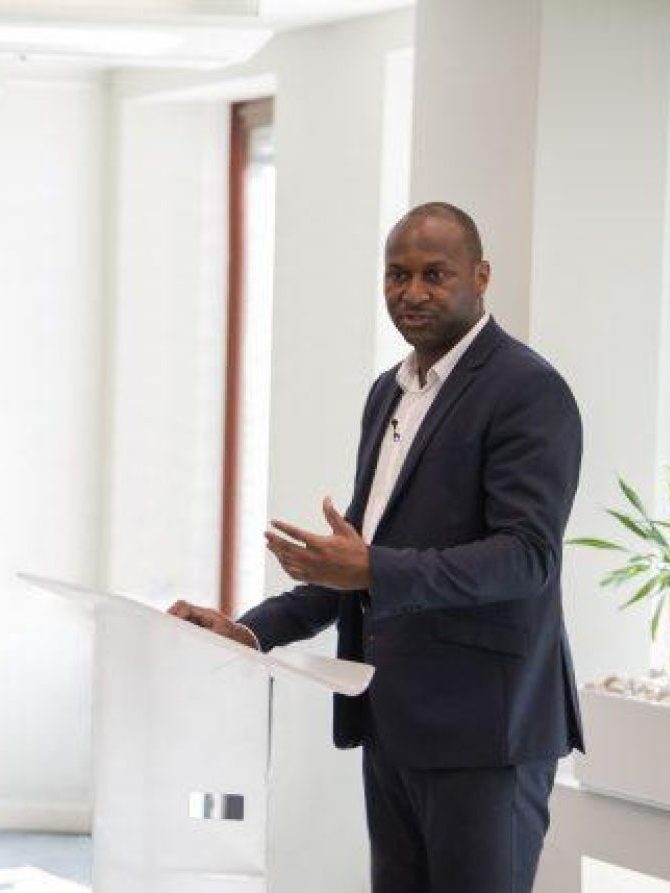
Dere Ogbe, a certified engineer, moved beyond hands-on technical tasks when his path shifted through an MBA. He did not become a leader by luck but with hard work and learning in the classroom. Dere obge began in a world of formulas and technical work, but now he makes bigger decisions. He still keeps his technical knowledge, but he also thinks more about strategy and business leadership. The change wasn’t about leaving one field behind, it was about growing into a bigger role.
Dere worked deep in engineering jobs for twelve years before he ever considered doing an MBA. At BP Exploration, he shaped operations as a top engineer focused on sharpening performance. His work spread best methods across big projects spanning Europe, the Middle East, and North Africa. Over time, he began to see how business decisions influenced technical outcomes. This understanding quietly drew him closer to leading teams beyond pure engineering.
Being accepted into the Sainsbury Management Fellows programme opened doors for Dere, letting him study an MBA at London Business School without tuition worries. That chance placed him in classrooms where numbers, decisions, and people met head on. He soaked up ideas about leading teams, finance, markets, and thinking ahead. Leadership stopped feeling like guesswork. Strategy became less abstract. The MBA filled gaps his earlier training had left open.
With an MBA in hand, Dere shifted toward a fresh professional path. At Shell, he stepped into senior management roles focused on strategy. His work connects complex technical challenges with practical business choices. The tools he learned in business school have influenced his style of planning and making key decisions. His understanding of global economic trends and future energy needs influenced the strategic efforts, which later became the foundation of his work that won a Strategy Excellence Award.
Dere links his improved decision-making skills, communication, and understanding of operations to the MBA program. The transition from being a technician to a leader occurred when theory was applied to reality. His confidence grew gradually.
Mandira Karmakar: Shifts from Architecture and Music to MBA

Not many follow the road Mandira Karmakar has taken. Education in architecture came first, at NIT Rourkela, yet melodies always pulled just as strong. Music wasn’t just a hobby for her.
Right after college, Mandira stepped into architecture consulting—handling crews, customers, and deadlines without pause.
Early days in music brought small contests; those slowly opened doors wider. One performance after another stacked up, more than fifteen hundred now, stretching through India and into the U.S. A spot-on national television arrived too, not by chance, but from showing up again and again.
Yet the more she dove into music, the clearer it became: unfair deals waited behind the spotlight, paths forward felt shaky at first, women often pushed aside. That truth hit hard—the brilliance of artistry needed backbone from sharp thinking to smart planning.
Now she wants an MBA.
Trying the GRE again and again became her rhythm, each attempt layered with quiet uncertainty.
Eventually, McCombs opened its doors. Admission came not through luck but through steady motion. She waited for her acceptance letter.
A visa denial nearly closed one door completely. Still, she pressed forward, paper by paper, step by step. After trying again and again, her visa was finally accepted.
For those who create, an MBA might not seem obvious—yet it can shape creativity in reality. It did for her. After completing her MBA, working in strategy or consulting felt right, particularly within media or fast-moving tech firms, then stepping into starting something of her own. Only after that would she move forward on her terms.
What began as sketches and doubt grew into structure, then strategy, then a future.
Dr. Soubhagya Sagar Behera: From Clinical Doctor to Healthcare Strategist via MBA
A doctor who once spent years treating patients took a sharp turn into boardrooms. After six solid years diagnosing illnesses, he stepped back and rethought the direction. His name is Soubhagya Sagar Behera—trained at AIIMS, Delhi, where textbooks and hospital shifts shaped his early days. Medicine came first; leadership later. A full-time MBA at IIM Bangalore became the next chapter. Clinical insight met strategy there. The move wasn’t impulsive—it followed quiet planning. Healing bodies led to managing systems.

Not everyone gets why Soubhagya stepped away from medicine—truth is, he liked seeing patients. Yet he believed real change wouldn’t come just from appointments in exam rooms. Fixing deeper problems—like access, structure, even leadership—mattered more to him. An MBA appeared as a path, not an escape, guiding him toward influence beyond the clinic walls.
A full six years of work history set him apart when he joined IIM Bangalore. He spent his summer break interning at Glenmark Pharma. After earning the degree, he stayed close to medicine by stepping into healthcare strategy. His next role was Project Manager at PharmaAce, where science and business connect daily.
At first returning to learning felt strange, especially when old topics such as math showed up rusty and grading systems felt unfamiliar after time away from classrooms. At first, stepping onto campus made him feel slow beside the classmates with sharper tech skills and fresher degrees. Yet exposure to new ways of thinking slowly shifted. Ideas began arriving differently. His voice found stability where it once hesitated.
What These Stories Show
These routes through engineering, art, and medicine share one thing in common: career trajectory switches are less about abandoning the past than about expanding its scope. Each story demonstrates how deep expertise only gains power when paired to business thinking-whether it’s moving technical knowledge into strategy, copyrighting creative work with structure, or scaling healthcare’s impact well beyond the clinic. An MBA didn’t replace who they were; it reframed how they thought, decided, and led. Growth came from persistence, exposure, and an openness to seeing problems as systems and not parts. Taken together, these stories show that career switching is not a leap away but a step into broader influence.