
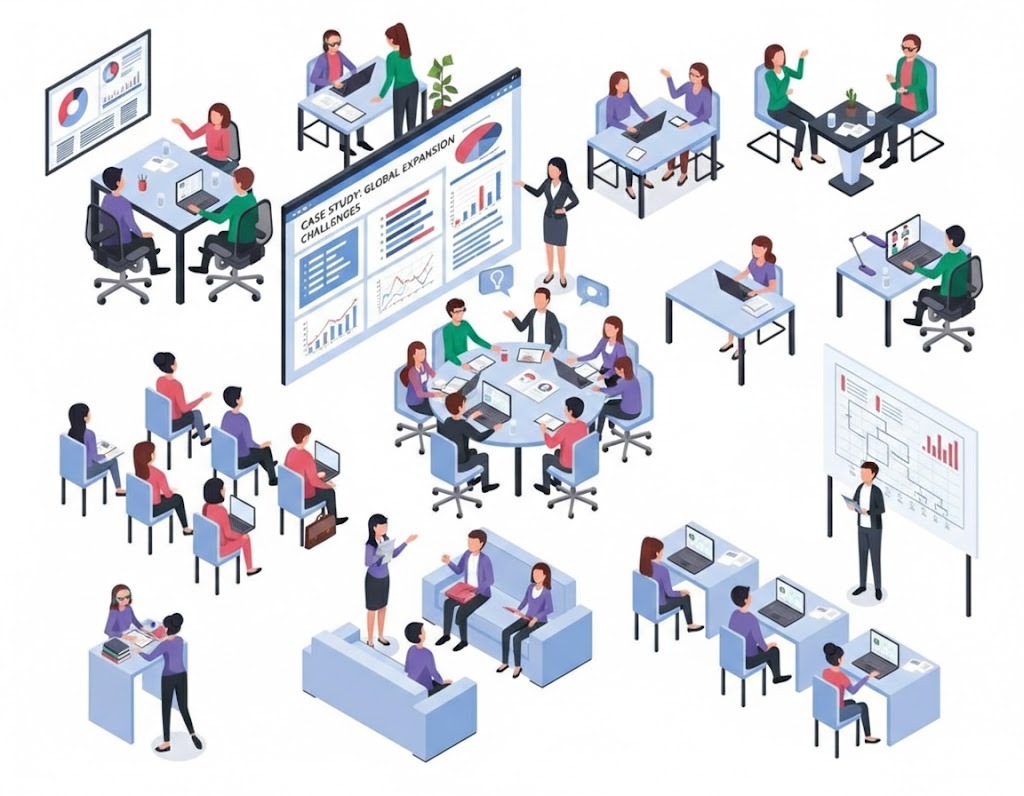
Case-based learning is a teaching method where the students learn and study real business situations, known as cases. These cases will describe the actual challenges faced by the companies such as market entry decisions, declining sales, leadership conflicts, financial problems and operational failures.
Student get to learn:
- Analyse data and situations
- Apply management concepts
- Discuss possible solutions
- Understand the problem
- Defend decisions with logic and evidence
Usually there will be no exact correct answer, but the main focus is on thinking, reasoning, and decision making, an essential approach followed by every Top B School offering an industry-oriented MBA program.
Why is case-based learning important in an MBA program?
A lot of people feel that choosing an MBA is all about reading books, exams, or equations, but in fact the MBA program is all about preparing students for life and the best way that the MBA program trains them for life is by case method.
Case-based learning places students in the role of decision-makers. Instead of being told what is right or wrong, they are given real business cases mostly done by top companies.
Like Benjamin Franklin said
“Tell me and I forget. Teach me and I remember. Involve me and I learn.”
This approach doesn’t just teach business. It changes the way students think. Which is why it is widely practiced in every Industry Oriented Institutes and Top B Schools.
How case-based learning shapes future leaders
1.Turns theory into action
The concepts like strategy, marketing, finance, and leadership will help students see how these ideas are actually used in real life. They also try to find the answers to the questions like:
- Why did a company succeed or fail?
- What decision should the manager take now?
- What could be done better?
This way of learning helps students to:
- Think clearly and logically
- Solve problems step by step
- Take decisions even when the situation is unclear
This approach is a key reason why leading management colleges and Best MBA Colleges in Vijayawada focus strongly on case-based learning.
“Learning by doing it is the best kind of learning.”
2. Teaches decision-making under pressure
Cases usually contain only limited information but involve important decisions. This will help student to learn to think smartly, and to take right action even in under pressure
In real life, great leaders are not the ones who know all the answers, but the ones who know what questions to ask
For example – Marketing strategy Case
A case in which a beverage company is losing sales to the young consumers.
Sales data, competitor moves, and customer habits are shared.
Now when students analyse why these sales are dropping, maybe the brand did not match the trends or maybe the competitors are winning over the youth.
Students need to find a solution for the problem faced by the company. This will help students to know how marketing concepts like market segmentation, consumer behaviour and also brand positioning work in real life.
How case-based learning develops soft skills
Case based learning mostly focuses on soft skills more than just technical knowledge.
Skills that will develop are:
- Teamwork through group discussions
- Communication through presentations
- Leadership
- Critical thinking
Regularly going through case studies help students to feel more confident while speaking in class. They will learn how to clearly explain what they think and why they think that way, using the points from the cases studied instead of just guessing.
These are the qualities expected from graduates of the Best MBA Colleges.
Difference between traditional learning and case-based learning
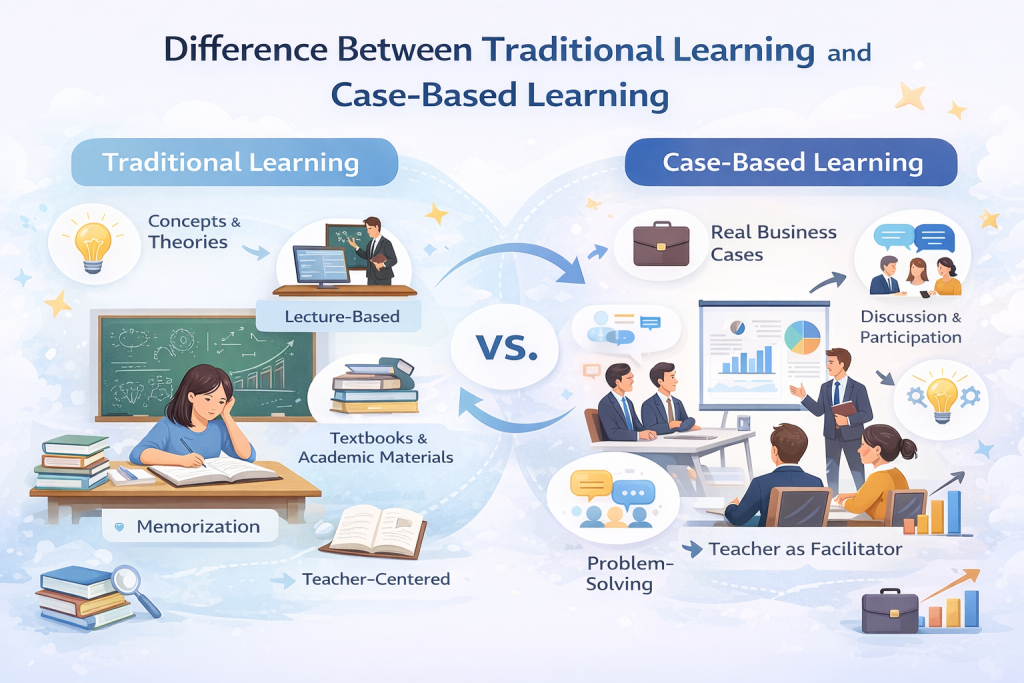
Management topics can be taught in various ways. Traditional learning and case-based learning differ mainly in how the students understand and apply these concepts.
Traditional learning
- Focus mainly on theory and textbooks
- Looks for one correct answer
- Exam oriented
- Limited real-world exposure
Case-based learning
- Focuses on applying concepts to real situations
- Allows multiple possible solutions
- Strong industry and real-world exposure
- Active participation and discussions
Conclusion:
Case based learning helps students to learn concepts clearly by working on real business problems, they can understand how these companies actually operate.
This method will build practical thinking and prepare students to handle real workplace challenges with confidence, making it a defining feature of every top B School and Best MBA College that aims to provide an industry-oriented MBA program.
Case-Based learning at FBS
At FBS, a recognized Top B School and Best MBA College in Vijayawada, learning through cases is well integrated in terms of curriculum of MBA programs to promote strong industry relevance.
As an Industry Oriented Institute, the focus of learning and discussions of cases inspired by real-world scenarios and business situations is to create an atmosphere similar to the real business environment or the environment of real business decision-making.
The industry-integrated MBA program at FBS provides exposure to the real world, develops the ability to think critically, and promotes learning through the collaborative spirit of the students, helping them become confident managers with managerial strength, ready to succeed in today’s competitive business world.