
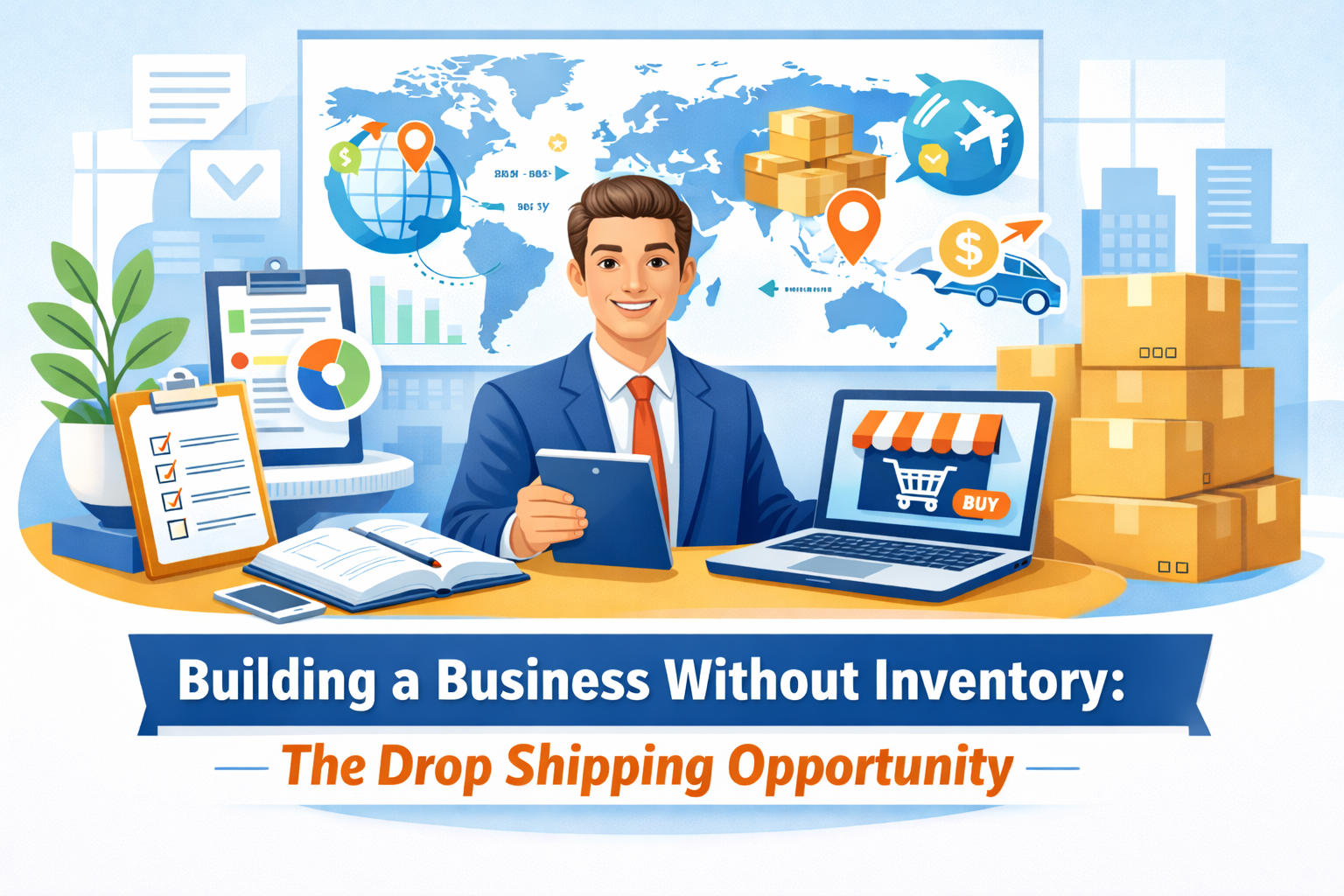
While business in a classroom environment may give one a sense of a theoretical framework, true understanding is often achieved by navigating real-world business decisions. For many aspiring MBAs, particularly those returning to school after a gap, this is one of the most important learning objectives. Learning about new business models that operate without traditional constraints may give one a new perspective on increasing understanding. The drop shipping business is one model where one is able to interact with all aspects of business.
At its core, drop shipping is a business model that enables the online sale of products through a third-party supplier. The supplier handles storage and shipping of the products to the customers. This business model changes how businesses manage inventories by eliminating the need to store products physically.
This model is ideal for anyone trying online business without inventories, reducing risks while enabling testing of different products. To start a drop shipping business, strategic decisions are often needed regarding products, suppliers, and online store setup.
Understanding the Dropshipping Business Model
In creating an inventory-free business model, one realizes the interconnected nature of business processes that theoretical studies seldom illustrate.
While determining how to drop-ship a product, one must consider customer acquisition cost, pricing, shipping time, and reliability.
Drop-shipping platforms facilitate these processes; however, understanding their interaction with marketing strategies, payment gateways, and shipping processes is practical learning. This could be beneficial to MBA aspirants to enhance their analytical thinking capabilities.
Practical Learning and Business Interconnectivity
Practical experience with drop shipping will also promote iterative thinking. Unlike other businesses that may incur great loss from wrong stock assumptions, an inventory-free business promotes iterative thinking.
For example, an entrepreneur may try different marketing strategies, niches, and working relationships to see what works best. This will further promote a thinking pattern that will be consistent with the principles of continuous improvement. The principles that have been discussed are not limited to an ecommerce environment. They are applicable to any process where there is a need to align resources, risks, and customers.
Core Skills Developed Through Drop shipping
- Digital Marketing and Customer Engagement: When it comes to dropshipping marketing campaigns, there will be a need to understand the following. Each strategy has a direct impact on conversion rates, which offers insights into demand generation and branding.
- Supplier Relationship Management: The need to work with dropshipping suppliers requires effective communication, negotiations, and coordination. Ensuring quality products and timely delivery would improve skill sets in evaluating suppliers.
- Financial Planning and Cost Analysis: Although a low-investment business, dropshipping does require proper analysis of margins, business costs, as well as marketing return on investment. Entrepreneurs will learn the importance of cost-effectiveness as well as customer convenience, which will improve their skills pertaining to better financial planning scenarios.
- Operational Problem Solving: Delays, returns, as well as inconsistencies with respect to inventory pose a challenge. Managing these situations will improve skills pertaining to adaptive thinking.
Despite its advantages, dropshipping does have its challenges. Entrepreneurs may have to cope with situations where there are delays in supply, unexpected freight costs, or unexpected product availability issues. Another marketing fatigue issue is that marketing strategies have to be modified periodically to retain customers. The involvement of third-party suppliers always carries some risk beyond one’s control. These are some issues that show that an inventory-free business is not without issues, and this is where an MBA aspirant’s understanding of risk and interdependence comes into play.
For those who are planning to pursue an MBA course after a career gap, working with dropshipping can provide valuable experience that can be used in conjunction with what they are taught in an MBA course.
Running a dropshipping business can provide valuable experience in entrepreneurial problem-solving, decision-making in uncertain conditions, and integrating different functions in a business. Such valuable experience can be used to one’s advantage while applying for an MBA course.
Conclusion: Advancing Practical Business Skills at FBS Business School
Moreover, those who are planning to pursue an MBA course can find that working with dropshipping can provide valuable experience in line with what FBS Business School offers in its MBA course in terms of providing valuable experience in running a business. Valuable experience in dealing with dropshipping challenges and strategies for sustainable growth can provide valuable experience in developing entrepreneurial skills.
In conclusion, dropshipping is an excellent example of a business model where theory and practice blend seamlessly. The environment is very observable. By running a dropshipping business, an entrepreneur interacts with concepts in marketing, finance, and operations. The environment is very dynamic and similar to the challenges in running a business.
To an MBA aspirant, particularly one coming back after a gap in service, running a dropshipping business helps build analytical skills. It also builds strategic thinking. Although the immediate objective is to create a passive income model with minimal risks, it provides an opportunity to develop skills. These skills can be applied directly towards an MBA. It also provides a good understanding of the significance of experience in creating a profound understanding of business in contemporary times.