In today’s fast-paced business world, it is not enough for future managers to only have knowledge. Employers require graduates to possess practical knowledge, thinking skills, and leadership skills from day one.
Therefore, today’s MBA programs are changing the way business education is delivered by including innovative approaches such as business simulation and simulation learning.
These business learning tools take students beyond books and lectures and encourage them to actively participate in decision-making situations that simulate real-life business challenges, helping them build the confidence needed to become business leaders.
Understanding Business Simulation in MBA Programs
A business simulation is an interactive learning technique that simulates a business environment. In many MBA programs, students are provided with a simulated business environment in which to operate and strategize their business operations.
Experiential learning MBA programs that incorporate business simulation allow students to try business strategies, fail, and learn from their mistakes. It is a technique which transforms traditional methods of learning into interactive learning MBA programs which combine theory and practice.
Through business strategy simulation, students in MBA programs can act in various capacities, such as CEO, marketing manager. As a result, they analyze business information and strategize business operations, learning from the results of their decisions.
This is a dynamic tool in teaching students within an MBA program and can provide them with necessary skills to deal with complexities in today’s business environment.
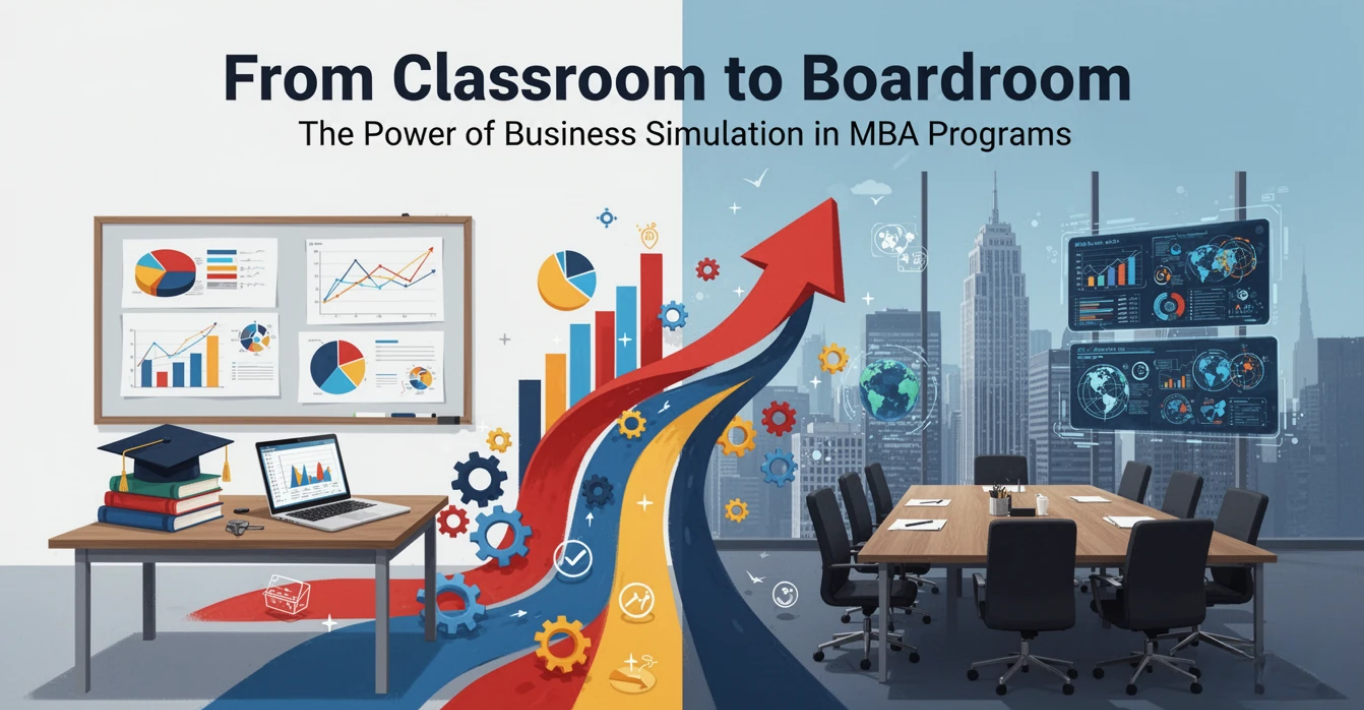
Bridging the Gap Between Classroom and Corporate World
One of the major advantages of simulation-based teaching is that it provides students with practical business experience within a classroom. Students learn to tackle a competitive environment, changing markets, financial squeezes, and business operations.
With business case simulation and management simulation, MBA students are able to practice business problem-solving in a collaborative environment. This equips them to think strategically and make informed decisions.
As a result, students develop business decision-making skills and experience a practical environment similar to a corporate boardroom.
Development of Leadership and Strategic Thinking Ability
In contemporary businesses, there is a need for critical thinking and decisive action. Advanced-level MBA programs focus on developing leadership abilities.
Through business strategy simulations, they impart the following abilities to students:
- Analyzing critical business situations
- Leadership abilities
- Utilizing resources
- Adapting strategies for changing markets
Boardroom abilities are imparted to the students through these simulations, and they are able to understand the decision-making abilities of executives. These simulations are also used for corporate skills training.
Strengthening Professional and Managerial Skills
The integration of business management training and corporate skills training through the use of simulations helps students acquire the skills needed in the current work environment.
Additionally, the management simulation exercises enable students to acquire the following skills:
- Strategic thinking
- Data-based business decision making
- Communication and negotiation skills
- Problem-solving skills
The experiences are an integral part of the professional development MBA, and the students are able to acquire the skills employers need in their future managers.
Why Business Simulations Are Essential in Modern MBA Programs
Today’s best Business school programs recognize that practical experience is essential to ensure students are industry-ready upon graduating. This is why business simulation has emerged as an essential part of modern skill development-based MBA programs.
Students of today’s best MBA college programs are able to benefit from interactive and immersive learning experiences in an MBA program.
The students will be able to gain confidence in handling complex business scenarios with the use of business case simulation and business strategy simulation, which will ensure their smooth transition from academics to the business field.
The Role of Simulation in Future Business Education
The future of business education is going to depend on the increasing trend of using digital technology, analyzing data, and using simulation learning platforms.
Business training tools are being introduced in business schools to offer students an immersive learning experience. These learning tools help students to simulate strategies, risks, and market forces.
How FBS Business School Prepares Future Leaders
Moreover, FBS Business School is not only focused on learning processes. The institution, being a top Business school, incorporates cutting-edge teaching methods for an MBA class, which include simulation learning, business case simulation, and interactive learning methods for an MBA class.
The innovative business training tools at FBS Business School provide students with hands-on business experience. Which helps them acquire skills to become effective leaders in the boardroom. The emphasis is on developing leadership skills, corporate skills, and business management skills in students. Which helps them acquire a professional development MBA experience to manage with the challenges of the competitive business world.
Final Thoughts
Thus, the path from the classroom to corporate leadership demands more than theoretical expertise. With the advent of business simulation, experiential learning-based MBAs, and other cutting-edge management simulation techniques, new MBAs are redefining the art of corporate leader development.
By providing students with the opportunity to experience business in the real world, these innovative learning strategies are helping to build students’ self-confidence, enhance business decision-making, and acquire the skills necessary to succeed in the corporate world.
For the aspiring business professional looking to build their skills and obtain their MBA from the best MBA college, business simulation-based MBAs are the answer.