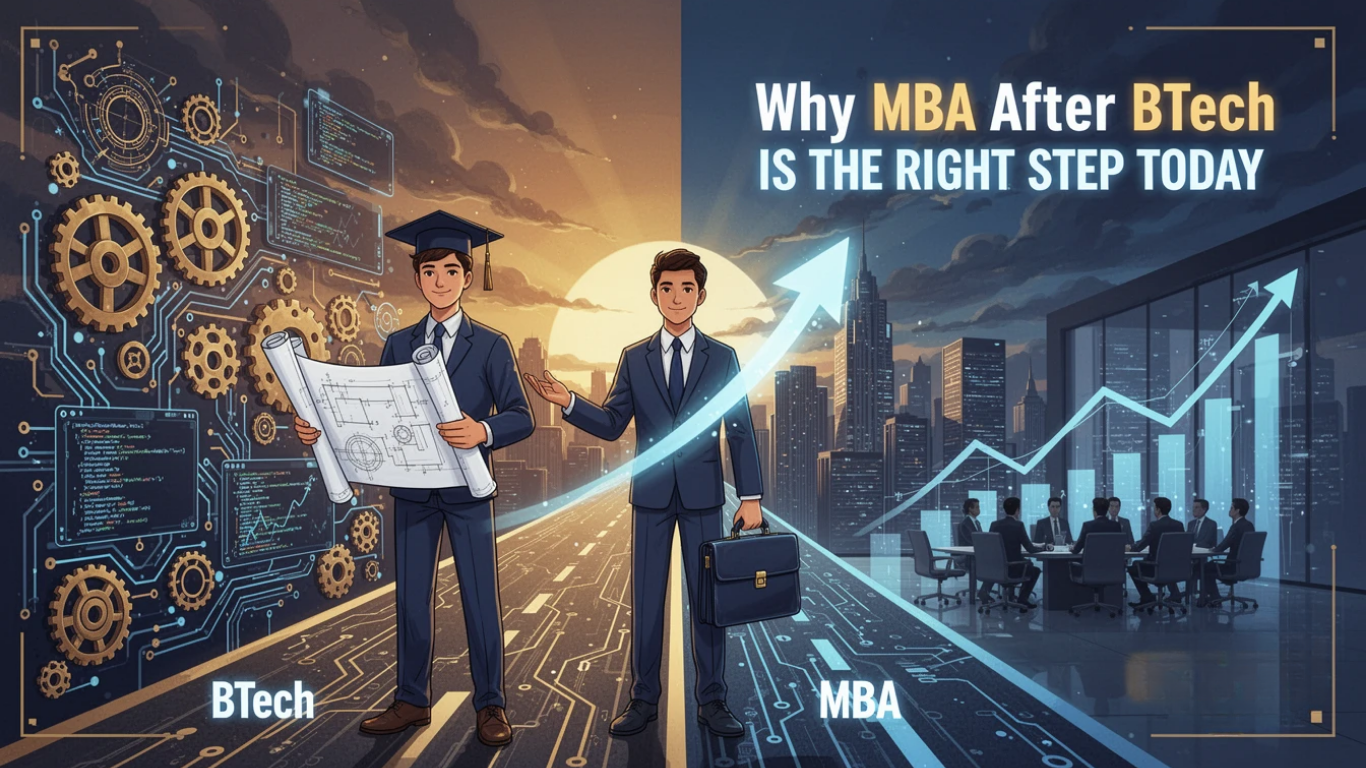
Completing a BTech degree is an achievement. It enhances strong technical and problem-solving skills. However, in the present competitive world, technical skills only might not take anyone to a higher profession. MBA After BTech is becoming one of the most popular career choices today. It is a good time to join an MBA course after BTech in one of the Best MBA Programs in India.
The MBA helps graduates of engineering courses transcend machines, codes, and systems and move on to fields involving decisions and management.
Can I do an MBA after B.Tech?
Yes, MBA can be done after B.Tech. In fact, one of the most common applicants for an MBA includes engineering graduates. A BTech course equips you with a strong analytical and problem-solving foundation, which is essentially required for management studies and MBA for Engineers.
MBA courses are available to anyone from a variety of academic backgrounds, from engineering to science, commerce, and arts. They are accepted based on entrance exams, academic performance, or sometimes work experience, depending on the institute. Many students also apply through MBA Admission processes in Best MBA Colleges.
The Career Reality After BTech

After completing B.Tech, most of the students prefer the following paths:
- Campus placements or a job in a technical field
- Higher technical studies (MTech or specialization)
- Competitive exams
- Skill-based certifications
While technical jobs offer a good start, career growth may become slow after a few years. There are various posts that limit their possibilities to the execution stage only, while a promotion demands the ability to communicate effectively, to lead the employees, and be a leader. Engineers aiming for Career Growth MBA Programs often choose management education.
Ex: A software engineer can begin as a developer. However, after a couple of years of experience, for a promotion, supervision of a team, client management, or budget/product decision-making is necessary.
“An MBA fills this gap by teaching how businesses work as a whole.”
Why Are Technical Skills Alone Insufficient?
Engineering education mainly focuses on:
- How things work
- How to build or design systems
- How to solve technical problems
But organizations also need professionals who can:
- Lead teams
- Communicate ideas clearly.
- Understand markets and customers.
- Take financial decisions.
- Plan strategies for growth.
While a civil engineer might know how a building is to be constructed or designed, an MBA degree is beneficial in comprehending a project, costing, managing risk, and profitability in a business or project. These are key benefits of Industry Ready MBA Programs.
How an MBA adds value to B.Tech Degree
An MBA can enhance one’s engineering background through non-technical skills, which play a major role in one’s career development. Many students prefer MBA with Placements for long-term success.
1. Better Career Growth and Leadership Opportunities
The preferred hires for companies are those with knowledge of both technology and management. Engineering MBAs are regarded as potential candidates for the following:
- Team lead roles
- Project manager positions
- Business analyst roles
- Operations manager positions
In an IT company, a project manager needs to know the technical challenges as well as manage timelines, budgets, and client expectations. A BTech + MBA dual degree is a perfect fit for such jobs in Top Management Careers after MBA.
2. Exposure to Multiple Career Options
After BTech, career choices are often limited to one technical field. An MBA opens doors to various domains such as:
- Marketing
- Finance
- Human Resources
- Operations
- Business Analytics
- Product and Project Management
These opportunities are offered in Best MBA Programs in India.
3. Improved Communication and soft skills
One of the major challenges faced by many engineering graduates is communication. An MBA program focuses heavily on:
- Presentation skills
- Team Management
- Leadership development
- Public speaking
- Negotiation skills
These skills help a professional succeed in an interview, meeting, or leadership role, thus enhancing overall MBA Career Opportunities for Engineers.
4. Understanding How Businesses Work
MBA courses educate one on how organizations work through subjects such as:
- Finance and accounting Knowledge
- Marketing strategies
- Human resource management
- Strategic Management
- Business Law
This knowledge helps engineers put the entire process and organization into perspective and look beyond their own job. These topics are fundamental to Top MBA Colleges.
MBA Adds Business Thinking to Technical Knowledge
An MBA does not replace engineering education. MBA enhances engineering education with a business perspective.
- With an MBA, an electronics engineer can move into product management roles.
- A mechanical engineer with an MBA will have a future in operations or supply chain management.
- A computer science graduate with an MBA can work in consulting, analytics, or leadership roles.
This combination makes professionals more valuable to companies, especially in MBA Jobs for Engineers.
MBA Opens Doors to Multiple Career Paths
After BTech, career options are mostly limited to technical roles. An MBA expands these options.
Career paths after MBA include:
- Marketing and sales
- Finance and investment roles
- Human resource management
- Business analytics
- Consulting
- Entrepreneurship
Ex: A case study on a failing company would teach how decisions in marketing, finance, and operations lead to success or failure. Such learning is common in Best MBA Colleges with Industry Exposure.
Conclusion:
An MBA after a BTech can greatly transform technical skills into managerial or business knowledge. The program equips engineering graduates with opportunities to take managerial positions, faster career growth, and greater opportunities. The MBA benefits for engineers include leadership roles, better salary growth, and wider career options. In the present competitive atmosphere, the combination enables the creation of professionals with knowledge and flexibility. Many students aim for Top MBA Programs for Engineers to achieve this growth.
MBA After BTech at FBS Business School
FBS Business School offers an MBA program specifically designed to assist BTech students to transition from technical careers to managerial roles. The structure of the program is heavily dependent on the application of “case-based learning.” By the application of ” case-based learning,” actual scenarios of business environments are studied from the perspective of understanding marketing, financing, production, and other aspects of business. FBS is also recognized among the Best MBA Colleges in Vijayawada, offering MBA with Internship and Placement Support, making it a strong choice for students looking for Industry Oriented MBA Programs.