In today’s fast-changing business environment, theoretical knowledge alone is no longer enough to prepare future managers and leaders. Employers expect MBA graduates to demonstrate not only strong academic understanding but also the ability to make strategic decisions, work in teams, and respond effectively to complex business situations. One powerful educational tool that helps bridge this gap between theory and practice is the business simulation.
Business simulations allow MBA students to experience the dynamics of running a company in a competitive environment. By participating in these interactive simulations, students learn to analyse markets, make strategic decisions, and observe the real-time consequences of their choices. These experiences mirror real business challenges and help prepare students for leadership roles in the corporate world.
What Are Business Simulations?
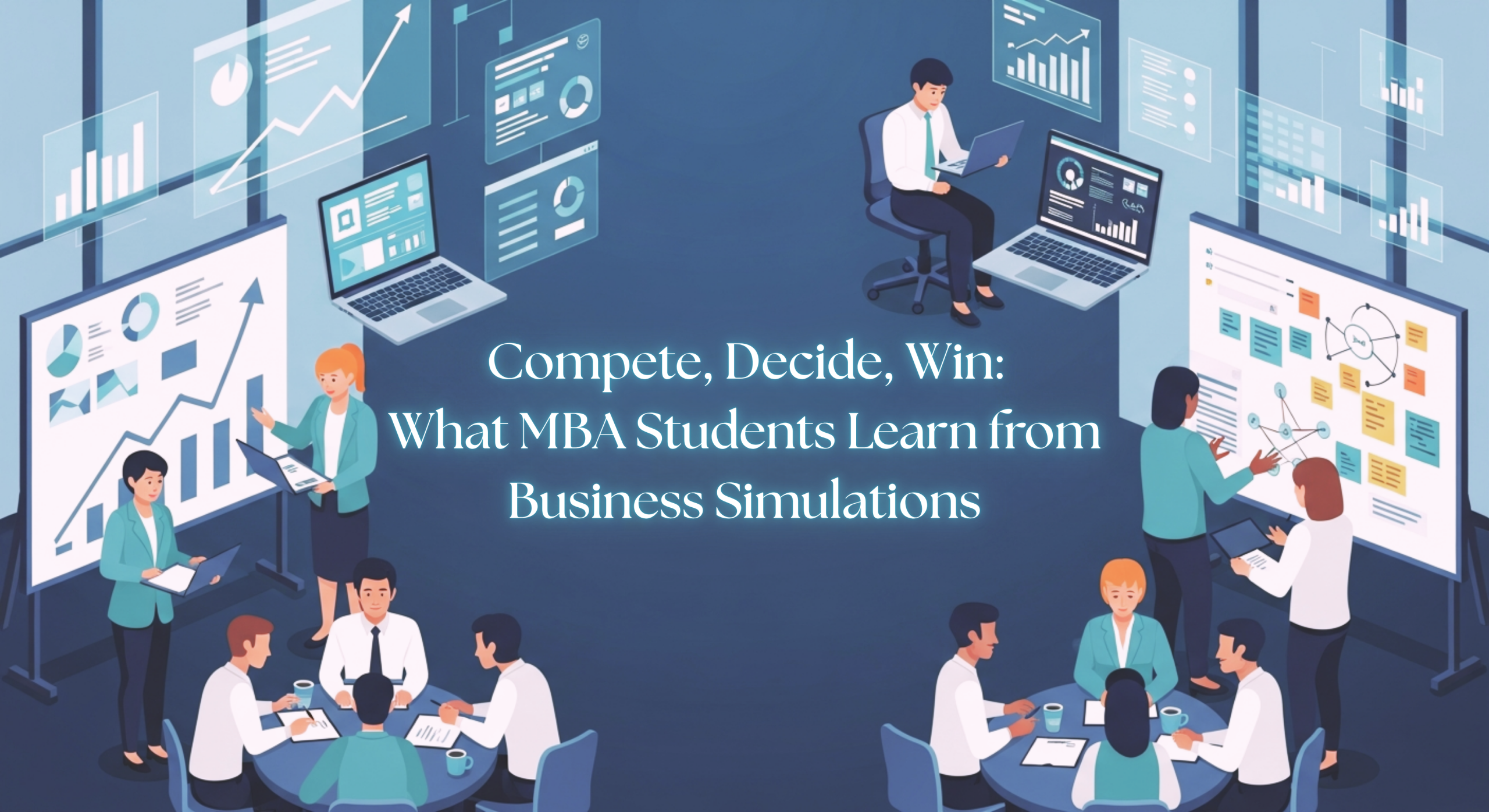
Business simulations are experiential learning tools that replicate real-world business scenarios in a virtual environment. In these simulations, students typically form teams and manage a fictional company competing against other teams in the same market. Each team must make strategic decisions related to marketing, finance, operations, and human resources while responding to market changes and competitive pressures.
Unlike traditional classroom learning, simulations require students to actively participate in decision-making processes. Students experience the consequences of their strategies, such as profit growth, market share changes, or operational challenges. This process creates an immersive learning environment that reflects the complexity of real business management.
Learning Strategic Decision-Making
One of the most important lessons MBA students gain from business simulations is strategic decision-making. In simulations, students must analyse market data, evaluate risks, and decide how to allocate resources effectively.
For example, teams might need to decide whether to launch a new product, invest in research and development, adjust pricing strategies, or expand into new markets. Each decision influences business performance indicators such as revenue, profit, and customer satisfaction. The ability to evaluate these options and choose the best strategy helps students develop the strategic thinking skills required in real managerial roles.
This environment also teaches students that business decisions rarely have a single correct answer. Instead, multiple strategies can lead to success depending on market conditions and execution.
Understanding Real-World Business Complexity
Running a company involves balancing multiple functions simultaneously. Business simulations help MBA students understand how different departments within an organization interact with each other.
For example, increasing marketing spending may increase sales but could reduce profitability if production costs rise. Similarly, cutting operational expenses might improve short-term profits but weaken long-term growth.
Through simulations, students learn how decisions in one area of business affect other functions, allowing them to develop a holistic view of business management.
Building Teamwork and Leadership Skills
Business simulations are rarely individual activities. Instead, they require students to collaborate in teams where each member may assume a specific role such as marketing manager, financial analyst, or operations leader.
This collaborative environment encourages communication, conflict resolution, and collective decision-making. Students must debate strategies, analyze different perspectives, and agree on the best course of action.
Such teamwork experiences mirror the dynamics of real corporate environments, where successful leaders must coordinate with colleagues from diverse departments and backgrounds.
Through these interactions, students strengthen their leadership and interpersonal skills—qualities highly valued by employers.
Learning from Failure in a Risk-Free Environment
One of the unique advantages of business simulations is that they provide a safe space to experiment and learn from mistakes. Students can test innovative strategies without facing real financial consequences.
If a decision leads to poor performance in the simulation, students can analyze what went wrong and adjust their strategy in the next round. This iterative process allows them to refine their decision-making skills and gain confidence in handling complex business situations.
Learning through trial and error helps MBA students develop resilience and adaptability—essential qualities for modern business leaders.
Receiving Instant Feedback and Performance Insights
Another important feature of business simulations is the immediate feedback they provide. After each round of decisions, teams receive detailed performance reports that include metrics such as profit margins, market share, customer satisfaction, and operational efficiency.
This feedback allows students to evaluate the impact of their decisions and adjust their strategies accordingly. The cycle of planning, execution, feedback, and improvement closely resembles real corporate decision-making processes.
By continuously analysing results and refining their strategies, students develop a strong analytical mindset.
Enhancing Employability and Career Readiness
Participating in business simulations also improves students’ career prospects. Employers increasingly value graduates who possess practical experience and demonstrate strong business judgment.
Simulation experiences show recruiters that candidates can apply business theories in real situations, collaborate with teams, and make strategic decisions under pressure. These skills enhance students’ resumes and prepare them for competitive job markets.
Many business schools integrate simulations into their MBA curricula precisely because they help students transition smoothly from academic learning to professional practice.
The Future of MBA Learning
As business environments become more complex and technology-driven, experiential learning methods like business simulations are becoming increasingly important. They transform traditional classroom education into an interactive learning experience where students actively engage with real-world challenges.
By combining competition, strategy, and collaboration, business simulations help MBA students develop the confidence and skills required to succeed in modern organizations.
Conclusion
Business simulations have become a vital component of modern MBA education. By immersing students in realistic business environments, these simulations teach critical skills such as strategic thinking, teamwork, leadership, and decision-making.
Through competition, analysis, and continuous improvement, MBA students learn how to navigate the complexities of business management. In essence, business simulations allow students to compete, decide, and ultimately learn how to win in the real business world.