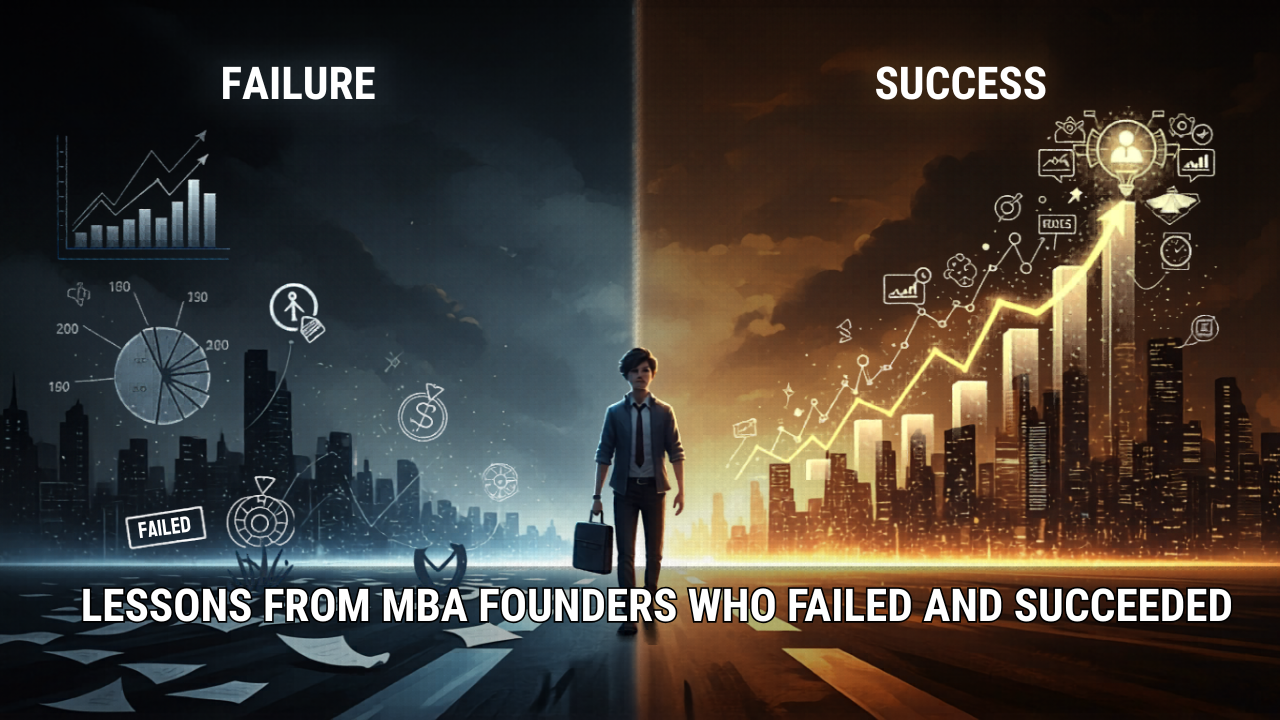
At FBS Business School, students are taught that being an entrepreneur is not only about the people who succeed. It is also about what students can learn from situations when things do not go as planned. Many people who graduated faced challenges before they were able to succeed. Some people even used their failures as learning experiences to become better leaders and make stronger decisions. FBS Business School students learn that failure is an important part of the entrepreneurial journey. The journeys of MBA founders’ lessons highlight how entrepreneurship involves both success and failure. These success stories of MBA entrepreneurs show that failed MBA startups often provide the strongest entrepreneurial lessons from MBA graduates. By understanding startup failures and comebacks, students gain valuable MBA entrepreneurship insights that prepare them for real-world challenges.
The journeys of MBA founders clearly show that business education is not about making sure you never fail. It is about learning how to handle difficult situations with a clear mind, a strong strategy, and the ability to bounce back. Many MBA founders share this common experience. Business education focuses on learning from mistakes, and MBA founders understand this well. These journeys teach us that business education is about resilience and finding ways to move forward when challenges arise.
Failure as a Foundation for Learning
At FBS Business School students learn how to look at problems and figure out what is going on. They think about what might happen and what they can learn from the results. When people start their businesses, they usually learn a lot from the things that do not work out as they thought.
Many people who finished their MBA had a time at first because they thought the market would be different or they started at the wrong time or they made mistakes when running their business. FBS Business School gets students, for these kinds of things by teaching them how to see the problems coming and how to deal with FBS Business School challenges.
MBA founders have to handle a lot of failures. These failures often happen because of timing or because things are not working smoothly. MBA programs show students how to think about what went wrong and come up with plans.
This way of thinking is really helpful for founders because it helps them learn from their mistakes. MBA programs also help founders figure out what they want to do and feel sure, about the decisions they make. MBA founders can perform better in the future because of the things they learn in MBA programs.
Real-Life Example
Evan Williams, an MBA graduate from Stanford Graduate School of Business, faced challenges with his startup Odeo, which focused on podcasting. When Apple entered the podcasting market, Odeo struggled to survive. Evan Williams and his team did not give up. Instead, they analysed what went wrong and changed their strategy. This led to the creation of Twitter. This example shows how MBA-style thinking and reflection can transform failure into success.
References:
https://en.wikipedia.org/wiki/Evan_Williams_(Internet_entrepreneur)
https://en.wikipedia.org/wiki/Odeo
Applying Classroom Knowledge to Real Markets
At FBS Business School students learn about strategy, finance and operations. The real markets do not always work the same way as the things students learn in class. FBS Business School teaches students a lot of things. Real life is different, from what students learn at Business Schools.
The people who started businesses and graduated with an MBA from Business School know that what they learned in class is not enough. They need to use the knowledge from the classroom in life. The MBA founders have to adapt what they learned to make it work in the world. They cannot just follow what they learned in class without thinking about how it applies to life situations. The MBA founders have to be smart, about how they use their classroom knowledge.
Business schools help students learn to think about things in a way to change their plans if something is not going right and to really look at what is happening in the market. These skills are really important when things do not happen the way you want them to, in business. FBS Business School teaches students these skills because real life is full of problems that require you to be flexible and make decisions quickly. FBS Business School knows that business situations can be tough and that is why they focus on teaching students to make quick, smart decisions in real-time situations by asking questions like “Your company is losing customers overnight. What will you do?”
Real-Life Example
Reed Hastings, an MBA graduate from Stanford GSB, applied strategic thinking while building Netflix. Initially, Netflix faced challenges with its DVD rental model. Later, the company had to change its strategy when it moved into streaming services. Reed Hastings’ ability to adapt his business model based on market needs shows how MBA education supports effective decision-making during uncertainty.
References:
https://en.wikipedia.org/wiki/Reed_Hastings
https://en.wikipedia.org/wiki/Netflix
The Importance of Customer-Centric Thinking
At FBS Business School they really focus on figuring out what customers need by doing marketing studies and looking at how people behave when they buy things. A lot of companies do not do well because their ideas are not bad. They do not really help people with their problems. FBS Business School teaches that many startups fail because they do not clearly understand customer needs, which leads them to create products that people do not actually want to use. This is a problem, for many startups because if they do not understand what customers need, they will not be able to make products or services that people will like. FBS Business School is trying to change this by teaching students about customer needs and consumer behaviour analysis.
FBS Business School is a place where students learn that knowing what customers want is really important for a business to do well. The education you get from an MBA program at FBS Business School helps students think about how to make customers happy and keep them coming for a long time. This is because customers are the key, to business success and FBS Business School teaches students how to understand customer needs and use that to make their business better.
When you get an MBA education you learn to listen to what your customers have to say. You take their feedback. Use it to make your products and services better.
The main goal of management education is to keep improving and to create value. These are the ideas that you learn in management education. You keep trying to make things better and to create value with an MBA education.
Real-Life Example:
Jeff Bezos, an MBA graduate from Princeton University, built Amazon with a strong focus on customer satisfaction. In its early years, Amazon faced challenges related to delivery timelines and service consistency. By continuously collecting customer feedback and improving operational processes, Amazon enhanced the overall customer experience and achieved long-term growth. This example demonstrates how customer-centric management practices, often emphasized in MBA programs, contribute to sustainable business success.
References:
https://en.wikipedia.org/wiki/Jeff_Bezos
https://en.wikipedia.org/wiki/Amazon_(company)
Leadership and Team Building
At FBS Business School, leadership development and organizational behaviour are core components of management education. Many startups fail due to leadership challenges, poor communication, or lack of team coordination rather than weak business ideas.
MBA programs help students develop skills related to people management, conflict resolution, and organizational culture building. These leadership skills are essential for aspiring entrepreneurs.
Real-Life Example
Travis Kalanick, an MBA graduate from UCLA Anderson, played a key role in Uber’s rapid growth. However, leadership and cultural issues later affected the company’s reputation, leading to his departure. This example highlights the importance of ethical leadership and people management, both of which are emphasized at FBS Business School.
References:
https://en.wikipedia.org/wiki/Travis_Kalanick
https://en.wikipedia.org/wiki/Uber
Risk Management and Strategic Decision-Making
At FBS Business School, students learn how to identify potential risks, manage finances, and make informed decisions. A lot of businesses do not do well because they don’t do a job of thinking about what might go wrong and making decisions. FBS Business School helps students understand Risks and manage risks in a way.
Getting an MBA education helps students learn how to make decisions based on facts and data. The MBA education teaches students how to think and make smart choices. This means that students who get an MBA education can balance making money with doing what is right for the environment. The MBA education also helps students make decisions even when things are not certain. The MBA education is really good, at teaching students these skills.
Real-Life Example
Indra Nooyi, an MBA graduate from Yale School of Management, demonstrated strong risk management and strategic leadership during her time at PepsiCo. Although she was not a startup founder, her career highlights how MBA education supports long-term business success.
Reference:
https://en.wikipedia.org/wiki/Indra_Nooyi
Resilience and Adaptability
At FBS Business School, students have to do presentations, work on case studies, meet deadlines, do group projects and take part in competitions that are like the real business world. These things help students at FBS Business School learn to deal with situations and be flexible. Students, at FBS Business School become better at handling pressure because of these experiences.
Founders who do well after they fail usually say it is because they can keep going and change their plans fast. Being able to do these things is really important for people who want to be entrepreneurs, in the long run. Founders need to be able to stay motivated and adapt quickly to be successful.
Real-Life Example
Howard Schultz, an MBA graduate, faced repeated rejections before expanding Starbucks globally. Through persistence and adaptability, he built Starbucks into a globally recognized brand. This reflects the resilience-focused learning environment promoted at FBS Business School.
References:
https://en.wikipedia.org/wiki/Howard_Schultz
https://en.wikipedia.org/wiki/Starbucks
Redefining Success Beyond Failure and Profit
At FBS Business School the people in charge do not just think that success is about how money a business is worth or how much profit it makes. They still become really good leaders, consultants and mentors because they use the things they learned at FBS Business School.
When we fail it helps us think clearly about our plans. It also makes us better leaders. Helps us make good choices. Learning about business is really about getting better at these things and failing’s a big part of that. Business education is about developing these skills and failure is often a key part of the learning process especially when it comes to strategic thinking, leadership skills and making ethical decisions.
People who started companies and got an MBA degree have failed sometimes and succeeded sometimes. This shows that starting your business is about learning new things all the time and getting better. At FBS Business School they want students to do things on their own, face problems without being scared and change the way they work when they need to. This way MBA founders and the students at FBS Business School can see that entrepreneurship and business are really about learning and growth and that is what FBS Business School is trying to teach. These MBA alumni success stories prove that startup success strategies taught in MBA programs help entrepreneurs turn setbacks into long-term growth.
By combining academic knowledge with practical exposure, leadership development, and customer-focused learning, FBS Business School equips future managers and entrepreneurs to transform both success and failure into meaningful learning experiences.
Conclusion
The stories of founders prove that success comes from resilience, strategy, and learning from failure. For students planning an MBA after graduation, choosing the right institute is key. Among the leading MBA colleges in Vijayawada, FBS Business School delivers strong Business management education through an industry-focused MBA course Vijayawada that builds leadership, risk management, and entrepreneurial skills. Recognized as the Best MBA college Vijayawada and one of the Top MBA colleges in Vijayawada, it offers a smooth MBA admission Vijayawada process with clear guidance on How to apply for MBA, making it one of the trusted Affordable MBA colleges for future-ready professionals.